

That does not mean handing over the decision. A good broker helps you understand what you are choosing so you can make a decision that fits your facility, budget, operating plans, and tolerance for risk.
Energy purchasing can feel like a specialist task that gets pushed down the list until a contract is close to expiring. By then, there may be little time to review the market properly or think through the options. This guide explains what an energy broker does, how the procurement process works, what questions to ask, and how to tell whether a broker is offering useful support rather than simply presenting a price.
Key Takeaways
An energy broker connects buyers and suppliers: The broker can gather and compare commercial energy options, but the customer remains responsible for choosing the route that fits the business.
The right contract depends on context: Usage patterns, operating schedules, budget priorities, renewal timing, and risk tolerance all affect the decision.
Price is only one part of procurement: Contract structure, terms, flexibility, supplier fit, and transparency also matter.
Education is a practical service: A broker should explain unfamiliar energy language and make the trade-offs visible before asking a client to commit.
First Off, What is Energy Procurement?
Energy procurement is the process of sourcing and purchasing energy—such as electricity, natural gas, or renewable energy—for residential, commercial, or industrial use. This involves negotiating contracts, securing the best rates, and managing energy supply agreements with utility companies or energy suppliers. Energy procurement is critical for businesses because energy costs can be a significant portion of operating expenses.
What Is An Energy Broker?
The broker is not the utility and is not necessarily the company supplying the energy. Their role is to help the buyer navigate the purchasing process. That can include reviewing historical usage, understanding the facility's requirements, gathering supplier options, discussing contract structures, and helping the client evaluate the full offer.
The phrase "best possible rate" is often used when describing brokerage. In practice, the best option is not always the lowest number on a quote. A lower rate may come with a structure that creates more exposure to market changes. A longer agreement may offer more budget predictability but less flexibility. A contract that works well for one facility may be a poor fit for another.
That is why a useful energy broker begins with questions. How does the facility operate? Is the business growing or changing locations? Is predictable budgeting more important than the chance to benefit from market decreases? Does the business have flexibility in when it uses energy? What sustainability or efficiency goals need to be considered?

Energy Contract Assessment
What type of energy procurement contract is best for my facility?
What Do Energy Brokers Do?
They learn how the business uses energy
A broker may review historical usage, facility information, operating schedules, locations, and contract dates. This context helps establish what the business actually needs before anyone starts comparing offers.
The more specific the understanding, the more useful the conversation can be. A facility that runs continuously has different considerations from a business with seasonal demand. A company planning an expansion may need flexibility that a stable operation does not. A finance team focused on budget certainty may evaluate the same offer differently from a business comfortable with more market exposure.
They monitor the market and gather options
Energy markets move over time, and available suppliers and products can vary by location. A broker can monitor market conditions and bring forward options that may be relevant to the customer's situation.
This does not mean that anyone can predict the market perfectly. Market monitoring is a way to improve visibility and preparation, not a guarantee of a particular outcome. A responsible adviser should explain what is known, what is uncertain, and which assumptions are behind a recommendation.
They compare more than the headline price
A commercial energy quote is not just a number. The buyer may also need to understand the contract term, pricing structure, pass-through components, renewal language, supplier terms, fees, and other conditions.
A broker can help put those details into a format that is easier to compare. The goal is not to make every option look identical. It is to show where the options differ and what those differences may mean for the business.
They help communicate with suppliers
Supplier conversations can take time, particularly when a business has multiple facilities or a more complex operating profile. A broker can coordinate requests, clarify questions, and help move the process from initial information through contract execution.
This can reduce the administrative burden on internal teams. It also gives the buyer a consistent point of contact while options are being gathered and evaluated.
They support contract decisions and renewal planning
The work does not necessarily end when a contract is signed. A broker may help with contract documentation, explain key terms, support account questions, and keep the next renewal from becoming a last-minute problem.
A1 Energy's existing procurement guide makes this point clearly: a contract expiration should not be allowed to "creep up" on the business. Planning early gives the client more time to understand the options instead of choosing under unnecessary pressure.
Why Facility Context Matters Before Price
The right energy procurement conversation starts with the business, not the rate sheet.
Two facilities can use similar amounts of energy and still need very different procurement strategies. A manufacturer with a consistent operating schedule may prioritize stability and straightforward budgeting. A business with seasonal operations may care more about flexibility and how the contract responds to changing demand.
Other factors can matter too:
The facility's location and available supplier market
Historical consumption and changes in usage
Operating hours and seasonal patterns
Planned growth, closure, relocation, or equipment changes
The importance of budget predictability
The business's ability to respond to changing prices
Sustainability, renewable energy, efficiency, or generation goals
The timing of the current contract's expiration
None of these factors produces an automatic answer. They create the context needed to ask better questions.
For example, a business that expects its energy use to change significantly may not want to evaluate a contract as if the next three years will look exactly like the last three. A facility with limited flexibility may place a higher value on predictability than a business that can shift some usage. A company considering on-site generation may need its procurement decisions to fit alongside a broader energy plan.
This is where an energy broker can facilitate the process. Instead of saying, "This is the contract everyone should choose," the broker can explain how different approaches relate to the client's circumstances.
That distinction matters. Advice is more useful when it helps a client see the reasoning, not just the recommendation.
Energy Contract Structures: Fixed, Index, and Blended Approaches
Energy contracts can be structured in different ways. The names and details vary by supplier and market, so the explanation below is a starting point rather than a substitute for reviewing a specific offer.
Fixed pricing
A fixed-rate contract sets the energy commodity price for a defined period. This can make budgeting easier because the agreed commodity price is less exposed to short-term market movement during the contract term.
The trade-off is that a fixed rate may not benefit from future market decreases. If the market moves lower after the agreement is signed, the business generally remains committed to the agreed price for the covered period.
Often considered by: Businesses that value predictability and want a clearer basis for budgeting.
Index pricing
An index structure links some or all of the energy price to a market index or changing market conditions. This may give a business more exposure to market movement and, depending on the structure, more flexibility in when or how it purchases energy.
The trade-off is less certainty. If the market moves higher, the business may experience higher costs. Index products require a clear understanding of how the price is calculated, what decisions the customer can make, and what risk controls are available.
Often considered by: Businesses with the capacity to monitor market movement and accept more variability in exchange for flexibility.
Blended or structured pricing
A blended or structured approach combines elements of fixed and market-based pricing. The structure may be designed around a customer's usage, timing, risk preferences, or purchasing strategy.
These arrangements can be useful when a business wants something other than an all-or-nothing choice between full predictability and full market exposure. They can also be more difficult to understand if the components are not explained carefully.
Often considered by: Businesses that need a more tailored approach and are prepared to review the details closely.
Before choosing a structure, ask:
Which parts of the price are fixed, and which can change?
What market or index is used, if applicable?
How are transmission, capacity, utility, taxes, and other charges handled?
What happens if the facility's usage changes?
What is the contract term and what are the renewal provisions?
What decisions will the customer need to make during the contract?
What risks are reduced, and which risks remain?
A1 Energy's procurement guide describes fixed, index, and blended rates as options whose suitability depends on usage and risk tolerance. That is the useful principle to carry forward: contract structure should follow the business context, not replace it.
How the Energy Procurement Process Usually Works
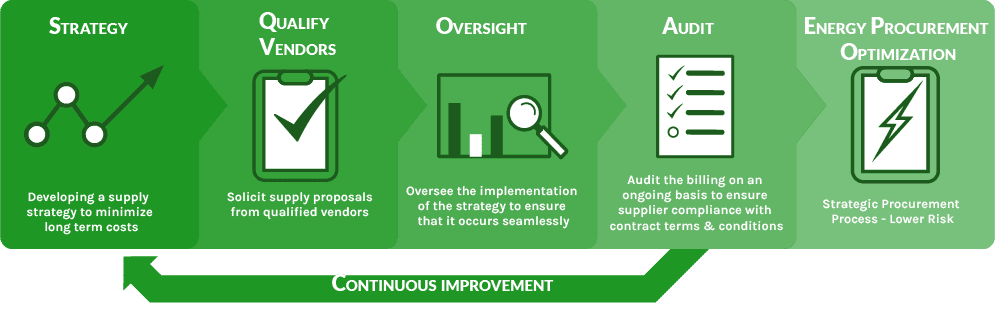
A well-organized procurement process gives the customer time to understand the decision. The exact sequence varies, but these are the stages most businesses should expect.
1. Prepare the information
The process usually begins with current contract details, account information, historical usage, facility locations, and renewal dates. Missing or inaccurate information can make comparisons less useful, so this preparation is worth doing carefully.
2. Clarify the business priorities
Before reviewing offers, decide what the business is trying to achieve. Is the priority budget certainty, flexibility, a particular contract term, renewable energy, or a broader efficiency plan? There may be several priorities, but it helps to identify which ones carry the most weight.
3. Review timing
The current contract's expiration date should shape the plan. Waiting until the final moment can limit the time available for questions and review. Starting earlier does not remove market uncertainty, but it can reduce decision pressure.
4. Gather relevant supplier options
The broker may request pricing or product information from available suppliers. A useful comparison should make clear which suppliers were considered, what assumptions were used, and whether every option is genuinely comparable.
5. Compare the full terms
This is where the headline rate needs context. Review the structure, term, included and excluded components, pass-through charges, flexibility, renewal language, and any conditions that could affect the final cost or the customer's obligations.
6. Discuss the trade-offs
The adviser should explain what each option does well and where it creates exposure or limitations. The conversation should make it easier for the client to choose, not make the client feel that questions are inconvenient.
7. Select and execute the agreement
Once the business has chosen its route, the broker can help coordinate the supplier process and clarify documentation. The customer should know what is being signed and what happens next.
8. Keep the next renewal visible
Procurement is not a one-time event. Contract dates, facility changes, market conditions, and business priorities can all change. Keeping a renewal calendar and reviewing the strategy before the deadline helps the next decision begin from a stronger position.
The result a business should have at the end of this process is not just a signed contract. It should also have a clear understanding of why the contract was selected.
What Tools and Market Information Add to the Process?
Not all energy brokers are created equal. While some rely on manual spreadsheets and delayed quotes from suppliers, top-tier brokers utilize advanced technology to gain a competitive edge for their clients. Having access to a professional pricing engine allows a broker to move beyond "guessing" and into "knowing." Here are the specific advantages these tools provide:
- Independent Price Verification: Most brokers have to wait for a supplier to send them a "matrix" or a custom quote. With the right energy pricing tools, you have access to a patented pricing engine that functions like an independent pricing desk. This allows you to calculate current and historical retail price estimates—broken down by supply, utility charges, and taxes—without needing to wait for a supplier’s feed. It’s the "Kelley Blue Book" of energy, ensuring the rates you see are fair and market-accurate.
- Real-Time Market Monitoring: The energy market changes by the minute. Professional tools act as an "energy stock ticker" for your specific facilities. Instead of checking rates once a quarter, we can monitor price fluctuations daily. This ensures that when a market dip occurs, we are alerted immediately to lock in a lower rate for your business.
- Custom Price Triggers: Energy procurement shouldn't be reactive. By using advanced platforms, we can set user-defined price triggers. If the market hits a specific target price that fits your budget, we are notified instantly. This automation removes the human error of missing a brief window of opportunity in a volatile market
- Detailed Cost Benchmarking: A great broker tool doesn't just show you a total price; it peels back the curtain on the subcomponents of your bill. We use these tools to show you exactly how much of your rate is going toward the actual energy commodity versus transmission, capacity, and ancillary costs. This level of transparency helps you understand exactly what you are paying for and where savings can be found.
Tools can also help an adviser watch market movement, set internal review points, and identify when a new comparison may be useful. But a tool does not decide what matters most to the customer. It cannot know whether a finance team values certainty more than flexibility unless the business explains its priorities.
The best use of technology is to support a better conversation:
Make assumptions visible
Compare like with like
Show how a price is constructed
Track timing and renewal milestones
How To Evaluate An Energy Broker
Ask about experience and fit
Has the broker worked with facilities similar to yours?
Do they understand your industry, operating pattern, number of locations, and likely constraints? Experience is most useful when it applies to the buyer's actual situation.
Ask how options are sourced
Does the broker work with multiple suppliers? Is the broker affiliated with a particular supplier? How will the available options be selected and presented? The answer should be clear enough for you to understand the scope of the comparison.
Ask how compensation works
A broker should explain how it is paid, whether the compensation comes from a supplier, the customer, or another arrangement, and how that might affect the process.
Ask what the comparison includes
A meaningful comparison should address more than the energy commodity rate. Ask whether the review includes contract structure, term, pass-through components, renewal provisions, supplier conditions, and other charges relevant to the offer.
Ask how recommendations are explained
A good adviser should be able to explain why an option may fit your business, what assumptions support the recommendation, and what trade-offs remain. If the explanation depends on urgency, pressure, or unexplained certainty, slow the process down.
Ask what happens after the contract is signed
Will the broker remain available for contract questions? How will market or account changes be communicated? Who should you contact if your facility changes before renewal?
What Is the Difference Between an Energy Broker and an Energy Consultant?
The terms energy broker and energy consultant can overlap, and providers may define their services differently. In general, an energy broker is often associated with sourcing and comparing supply options, while an energy consultant may provide broader advice across procurement, efficiency, generation, risk, or energy strategy.
The title matters less than the scope of work. Ask what the provider will actually do. Will they review contracts? Compare suppliers? Assess usage? Discuss efficiency? Help evaluate on-site generation? Support renewal? Explain the costs and responsibilities involved?
For a business, the useful question is not, "Which title sounds better?" It is, "Which capabilities and level of support match the decision we need to make?"
How Energy Procurement Connects With Efficiency and On-Site Generation
Buying energy is one part of managing energy. A broader plan may also include efficiency improvements, renewable energy, storage, on-site generation, load management, or other facility changes.
These areas can influence one another. A facility that improves efficiency may change its usage profile. On-site generation may affect how much energy it purchases from the grid. A business considering renewable energy may want procurement choices that support its wider sustainability goals.
We work across procurement, energy efficiency, and on-site generation. That three-part context is useful because it encourages businesses to look at the whole energy picture rather than treating the supply contract as an isolated administrative task.
You do not need to solve every energy question at once. Start by identifying the decision in front of you, then note the changes that may affect future procurement. This gives the broker or consultant a more accurate picture of where the business is heading.
Frequently Asked Questions About Energy Brokers
Is an energy broker worth using for a small or mid-sized business?
An energy broker can be useful when a business lacks the time, market knowledge, or internal resources to compare energy options. The value depends on the quality and transparency of the support, not simply the size of the business.
Does an energy broker guarantee savings?
No responsible broker should guarantee a specific saving without knowing the facility, market, contract structure, and comparison assumptions. A broker can help identify options and support an informed decision, but market movement and business usage remain uncertain.
How does an energy broker get paid?
Compensation varies. Some brokers may receive supplier-paid compensation, charge a fee to the customer, or use another arrangement. Ask for a clear explanation of the payment structure and how it is disclosed before choosing a provider.
Should I choose a fixed or index rate?
There is no universal answer. Fixed pricing may suit a business that prioritizes predictability, while index pricing may suit a business that can accept more market exposure. The decision should reflect usage, budget priorities, flexibility, and risk tolerance.
When should I start reviewing my energy contract?
Start before the expiration date becomes urgent. The right lead time depends on the facility, market, supplier, and contract, but early preparation gives you more time to gather information, compare terms, ask questions, and make a considered choice.
What information should I have ready for a broker?
Have your current contract, account and facility details, historical usage, renewal date, operating pattern, and expected changes available. It also helps to write down whether your main priority is predictability, flexibility, cost control, sustainability, or a combination.
Can a broker help with renewable energy or efficiency goals?
Some brokers and energy consultants can connect procurement decisions with renewable energy, efficiency, or on-site generation planning. Ask what is included in their service and whether they have the experience needed for the specific project.
Bottom Line: The Best Energy Broker Helps You Make a Decision You Understand
An energy broker can save a business time, organize supplier options, and bring useful market knowledge into the procurement process. But the strongest relationship is not built around a promise that someone else will make the decision for you.
It is built around clarity.
Before your next procurement conversation, write down three things: when your current contract ends, what has changed in your facility, and what matters most in the next agreement. Those notes will give you a better starting point and help you recognize whether an adviser is listening to the business behind the energy bill.
Energy procurement can be confusing to businesses of all sizes. At A1 Energy, we help make energy procurement easy by offering flexible solutions and a personalized approach to each new business relationship. A1 Energy also specializes in energy efficiency and on-site generation projects. This three pronged approach helps clients optimize their energy consumption and energy spend. If you’re interested in learning more about how we can assist you, schedule a call with one of our energy consultants to get started.